
- Détails
- Affichages : 1218
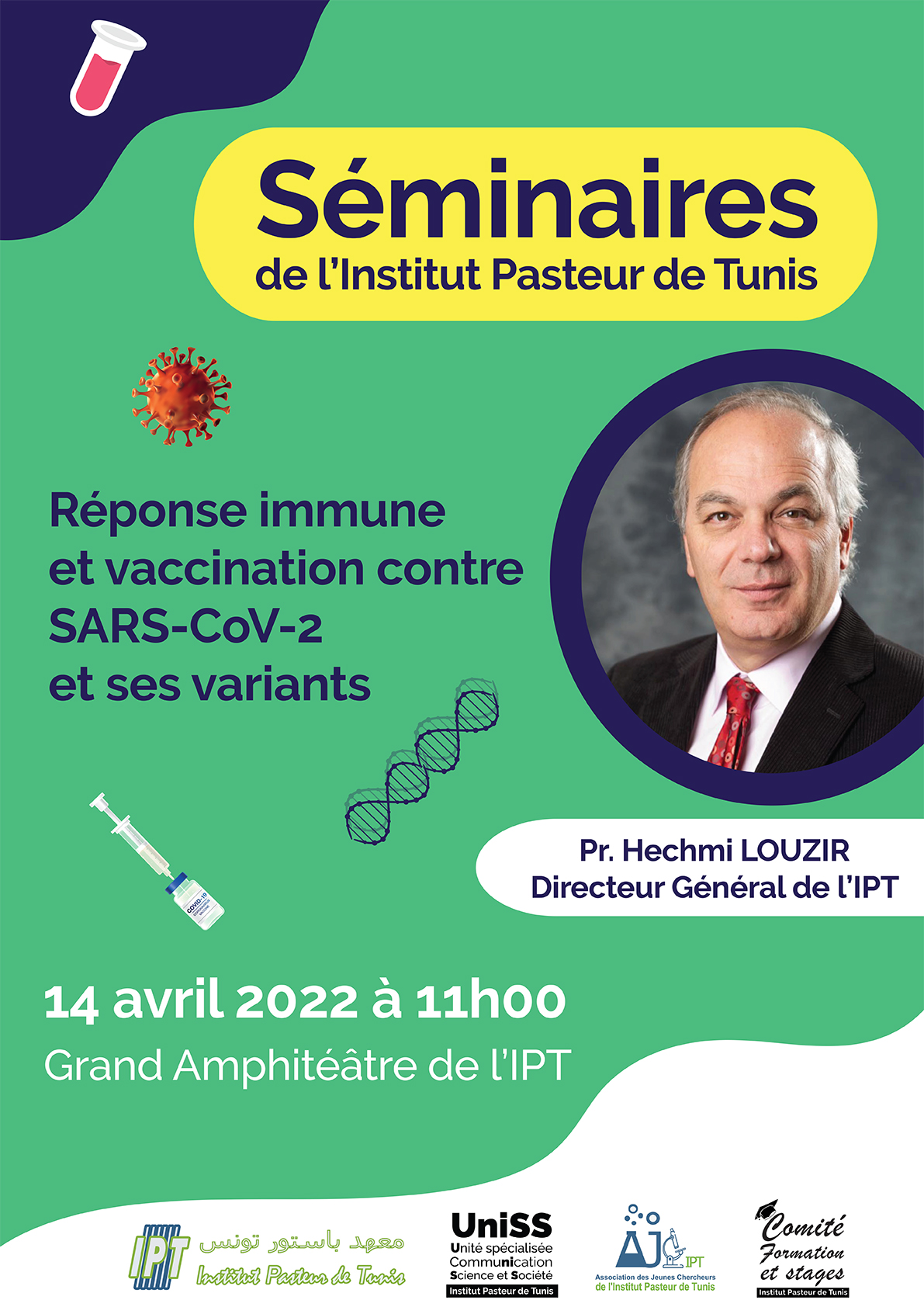
Les séminaires scientifiques de l'Institut Pasteur de Tunis font leur retour dans la vie de l'Institut.
Avec l'objectif de renforcer les échanges scientifiques entre pasteuriens et la communauté scientifique en général sur les thématiques de l'IPT, ces séminaires se dérouleront tous les 15 jours, les jeudis en fin de matinée.

- Détails
- Affichages : 1487
Le mercredi 15 septembre à 15h00, le projet européen PHINDaccess coordonné par l'Institut Pasteur de Tunis organise un café scientifique en ligne intitulé : La recherche sur les maladies infectieuses à l'ère de l'omique et des Big data.
- Détails
- Affichages : 711680
It's easy to get started creating your website. Knowing some of the basics will help.
What is a Content Management System?
A content management system is software that allows you to create and manage webpages easily by separating the creation of your content from the mechanics required to present it on the web.
In this site, the content is stored in a database. The look and feel are created by a template. Joomla! brings together the template and your content to create web pages.
Logging in
To login to your site use the user name and password that were created as part of the installation process. Once logged-in you will be able to create and edit articles and modify some settings.
Creating an article
Once you are logged-in, a new menu will be visible. To create a new article, click on the "Submit Article" link on that menu.
The new article interface gives you a lot of options, but all you need to do is add a title and put something in the content area. To make it easy to find, set the state to published.
Template, site settings, and modules
The look and feel of your site is controlled by a template. You can change the site name, background colour, highlights colour and more by editing the template settings. Click the "Template Settings" in the user menu.
The boxes around the main content of the site are called modules. You can modify modules on the current page by moving your cursor to the module and clicking the edit link. Always be sure to save and close any module you edit.
You can change some site settings such as the site name and description by clicking on the "Site Settings" link.
More advanced options for templates, site settings, modules, and more are available in the site administrator.
Site and Administrator
Your site actually has two separate sites. The site (also called the front end) is what visitors to your site will see. The administrator (also called the back end) is only used by people managing your site. You can access the administrator by clicking the "Site Administrator" link on the "User Menu" menu (visible once you login) or by adding /administrator to the end of your domain name. The same user name and password are used for both sites.
Learn more
There is much more to learn about how to use Joomla! to create the website you envision. You can learn much more at the Joomla! documentation site and on the Joomla! forums.
- Détails
- Affichages : 582

- Détails
- Affichages : 826


Santé publique
Contacts
13, place Pasteur, B.P. 74 1002 Tunis, Belvédère Tunisie
E-mail : info@pasteur.tn
Téléphone : +216 71783 022 / +216 71 843 755